
Hodgkins, Illinois
Concrete Contractor in Hodgkins, IL for Flatwork Planned Around Your Workday
Sidewalks, pads and slabs for businesses, plus driveways, patios and stamped work for homes in Hodgkins, Countryside, McCook and La Grange, poured on a timeline that keeps doors and docks open.
Figures you get before we break ground
Square footage
Measured on site, not estimated from a satellite photo.
Stone depth
How many inches of compacted base go under the slab, in writing.
Slab thickness
Matched to the heaviest load the concrete will carry.
Pour window
Which hours and which sections, mapped against your operations.
Cure time
When feet, cars and forklifts can go back on, stated up front.
Concrete Services for Hodgkins Properties
Seven categories. Some are commercial, most are residential, and plenty of jobs overlap. Each one is scoped, measured and scheduled before a single yard of concrete is ordered.
Concrete Flatwork
Flat pours of every footprint: loading aprons, equipment pads, pole barn slabs, shed bases and slab extensions. Base depth and thickness set by the load, not by habit.
Concrete Foundations
What a room addition, garage or porch stands on, from trench footings to thickened-edge slabs. Dimensions taken straight from the stamped drawings and checked twice before the pour.
Stamped Concrete
Textured, colored concrete in slate, cobble, brick or plank patterns. Planned in sections so each area is stamped at the right set time, then sealed as the final finishing step.
Concrete Walkways & Sidewalks
Entry walks, side paths and runs of sidewalk for houses and businesses. Cross slope, joint spacing and width all decided on paper first.
Concrete Patios
Patios sized by the furniture plan and pitched by the numbers: a steady fall away from the foundation toward somewhere the water can go.
Concrete Driveways
Replacement and new driveways. Break-out, excavation, compacted stone, steel and a slab thickness chosen for what actually parks there.
Commercial Concrete
Storefront walks, trash corral slabs, dock aprons and condenser pads, sequenced around shift changes, freight pickups and the lunch rush.
Five Stages, Each With a Clear Finish Line
Phone call
Describe the project, the rough size and what is there now. For businesses, add your hours, shift changes and delivery windows. Ten minutes on the phone saves a week of back and forth later.
Site walk
We measure, shoot grade, check drainage and look at the condition of the existing slab. Access gets checked too: can a ready-mix truck reach the forms, or does the pour need a pump or buggies?
Written price and timeline
One document. Thickness, base, reinforcement, finish, removal and the schedule, line by line. Commercial jobs get a phasing plan showing which area closes on which day.
Prep
Tear-out and haul-away, excavation to firm soil, compacted stone base and forms set to grade. Most of the quality in a slab is decided here, before any concrete arrives.
Pour, cure, hand back
Placement, finishing, joints cut, then curing protection. Forms come off, the area is cleaned and you get a clear date for when it can take traffic again.
What Goes Into Every Slab We Pour
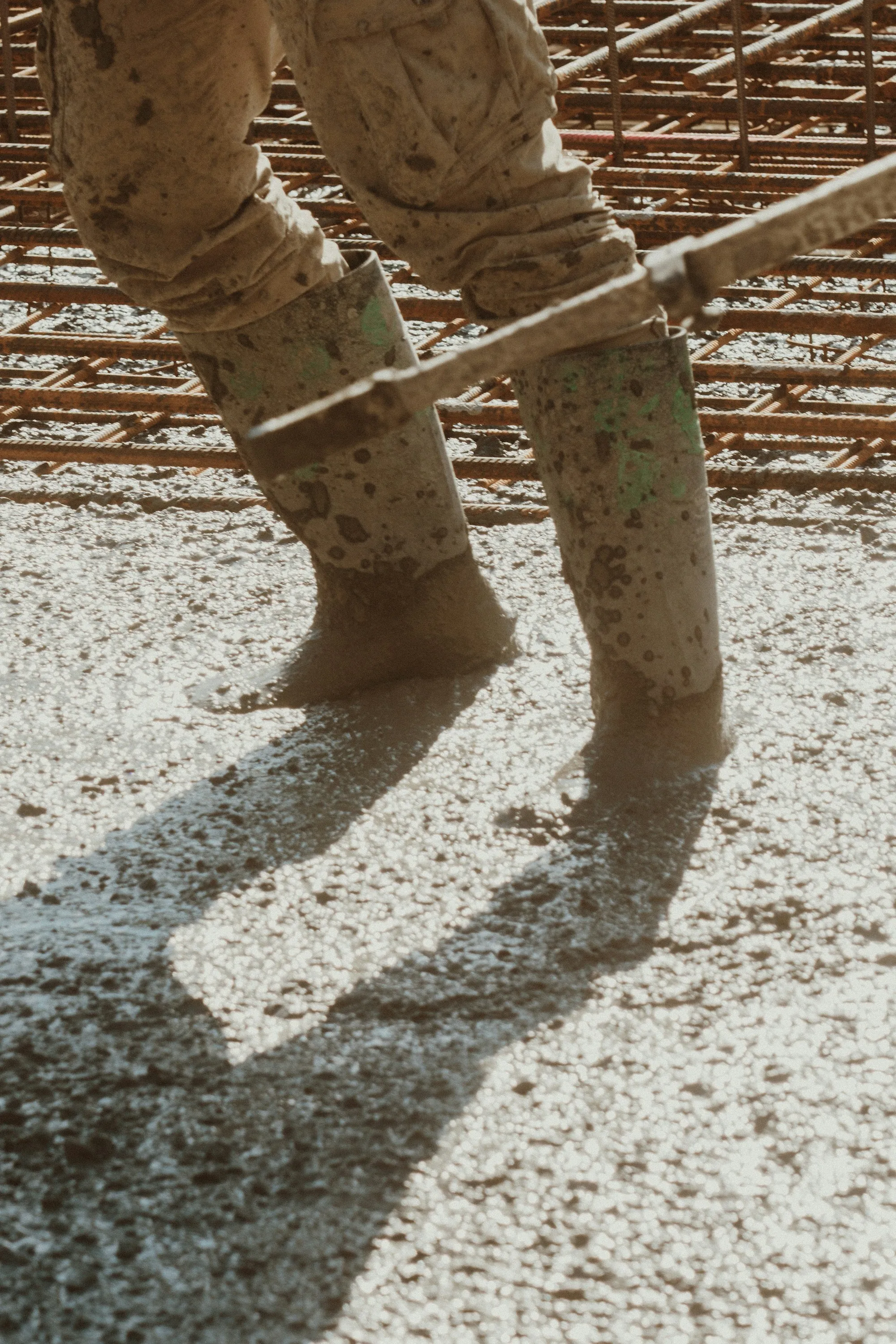
We have been pouring concrete since 2017, and the slabs that perform best all share the same four ingredients. None of them are flashy. All of them are measurable.
Base built to a number
We excavate to firm soil and add compacted stone to a set depth. That depth is written in your price. A slab is only as strong as what it sits on, and soft subgrade is the most common reason driveways and pads sink.
Drainage designed, not hoped for
Every slab gets a planned fall and a planned outlet: the lawn, a swale, a drain, the street. On commercial sites we look at where roof water and parking lot runoff already go so the new concrete works with them.
Decorative work done carefully
Stamped patterns and color take timing and a steady crew. We pour decorative slabs in manageable sections so every square foot gets textured at the right moment, then finish with a sealer coat.
Curing on a schedule
Fresh concrete needs moisture and time. We protect the surface after the pour and give you a firm date for foot traffic and vehicles, so nobody drives on a slab that is not ready.
Serving Hodgkins and Nearby West Suburbs
Hodgkins is a small village with a big commercial footprint. The I-55 and I-294 interchange sits right at its edge, La Grange Road and Joliet Road carry steady truck traffic, and warehouses, freight terminals and hotels share the map with quiet residential streets. That mix shapes our work: loading aprons and dumpster pads one week, a backyard patio or a new driveway the next. We cover Hodgkins and the Cook County communities around it, including Countryside, McCook, La Grange, Willow Springs, Justice, Summit, Hickory Hills, Brookfield, Bridgeview and Bedford Park.
Built for truck traffic
Commercial slabs near the interstates take heavy, constant loads. We size the base and thickness for that, not for a passenger car.
Residential streets, too
Hodgkins homeowners get the same planning: measured fall, set base depth and a clear cure schedule before the family car goes back on.
One contact, every town
From Brookfield to Bedford Park, (708) 847-4920 reaches the person who scopes, prices and schedules your job.
Communities we cover
- HodgkinsI-55 & La Grange RoadHome base
- CountrysideLa Grange Road & Joliet Road
- McCookJoliet Road
- La GrangeLa Grange Road & Ogden Avenue
- Willow SpringsArcher Avenue & Willow Springs Road
- JusticeRoberts Road & 79th Street
- SummitArcher Avenue & Harlem Avenue
- Hickory HillsRoberts Road & 95th Street
- BrookfieldOgden Avenue
- BridgeviewHarlem Avenue & 79th Street
- Bedford ParkCicero Avenue & 71st Street
Property a few miles outside this list? Ask. Larger commercial jobs often make the drive worthwhile.
Confirm we cover your site: (708) 847-4920Downtime Costs Money. A Good Pour Plan Saves It.
A closed entrance, a blocked dock or a dumpster with nowhere to sit all cost a business something. We plan commercial concrete in phases and windows that fit your operation, and we put that plan in writing next to the price.
Plan your phased pour by phone: (708) 847-4920Clear numbers on the first call. No commitment required.
Concrete Questions, Answered by the Numbers
The questions we hear most, with answers you can plan around.
How long does a concrete job take from first day to last?
Most residential jobs need two to five working days on site: a day or so for tear-out and base, a day to pour, and a return trip to pull forms and clean up. Commercial work in phases runs longer because each section cures before the next one closes. Add curing time before full use, and allow for weather, which can move a pour by a day or more.
What is meant by concrete flatwork?
Any concrete placed flat on prepared ground rather than formed vertically. Sidewalks, driveways, patios, aprons and equipment pads all qualify. Its performance comes down to four variables: base, thickness, drainage and joint spacing.
Does my project need a permit?
Often, yes. Most villages require permits for driveways, especially the apron at the street, and almost always for foundations. Patios and walks vary by town. We check what your village requires during scoping so the paperwork does not hold up the schedule.
How long will a concrete foundation last?
Built to plan, a foundation should outlive most of the house it carries, from the roof shingles to the furnace. What shortens that life is usually water and soil movement, not the concrete itself. Footings below frost depth, good drainage around the building and correct reinforcement do most of the work.
Should new concrete be sealed, and how often?
Stamped and colored concrete is sealed as the final step of our finishing, and a fresh coat every two to three years keeps the color strong and the surface protected. Plain broom-finish slabs depend mostly on proper curing for durability. If you want to seal a plain slab yourself later, wait until it has fully cured.
Rebar or wire mesh: which one, and why?
Yes, depending on the load. Rebar in a grid gives the most strength for driveways, aprons and commercial pads that carry heavy vehicles. Either one only works if it is held up in the middle of the slab during the pour, so we prop it on chairs instead of letting it rest on the stone.
What determines what a concrete driveway costs?
Five variables do most of the work: square footage, thickness, the amount of old concrete to remove, the depth of new base needed and the finish. Site access and reinforcement add to it. Your written price lists each variable so you can see how changes in size or finish move the total.
Is it better to repair my concrete or replace it?
Look at what failed. Fine surface cracks on a slab that is still level are mostly cosmetic and can be left alone. A slab that has sunk, heaved, broken into pieces or lost its pitch toward the house usually has a base problem underneath, and replacement with proper base and drainage is the lasting fix.
A Concrete Company That Plans the Work Before It Works the Plan
Concrete Contractor Hodgkins treats every job as a set of numbers to get right: base depth, slab thickness, fall, joint spacing, cure time and schedule. Businesses get pour windows that respect their operations. Homeowners get a driveway, patio or walk with nothing left to guesswork.
Read how we plan a job
Get the Scope, the Price and the Schedule on One Call
Give us the square footage if you have it, or a rough idea if you do not. We will talk through thickness, base and timing and tell you what the next step looks like.
Serving Hodgkins and the surrounding west suburbs.